Improving College Affordability: A Review of the Literature
Background
Higher education has the potential to generate extraordinary economic opportunities for those who attend (Haveman & Wolfe, 1984; Baum et al., 2013). Yet from the earliest days of colleges operating in America, access to the highest-quality, most heavily resourced colleges has been more readily accessible to children of the wealthy, due in part to the high price of entry (Goldin & Katz, 1999; Chetty et al., 2020). Students from high-income families are both more likely to attend college and to earn a degree than those from low-income families, and these gaps appear to have grown over time (Bailey & Dynarski, 2011). Today, just one in four Americans without a college credential believes people have access to a quality, affordable education (Marken, 2026).
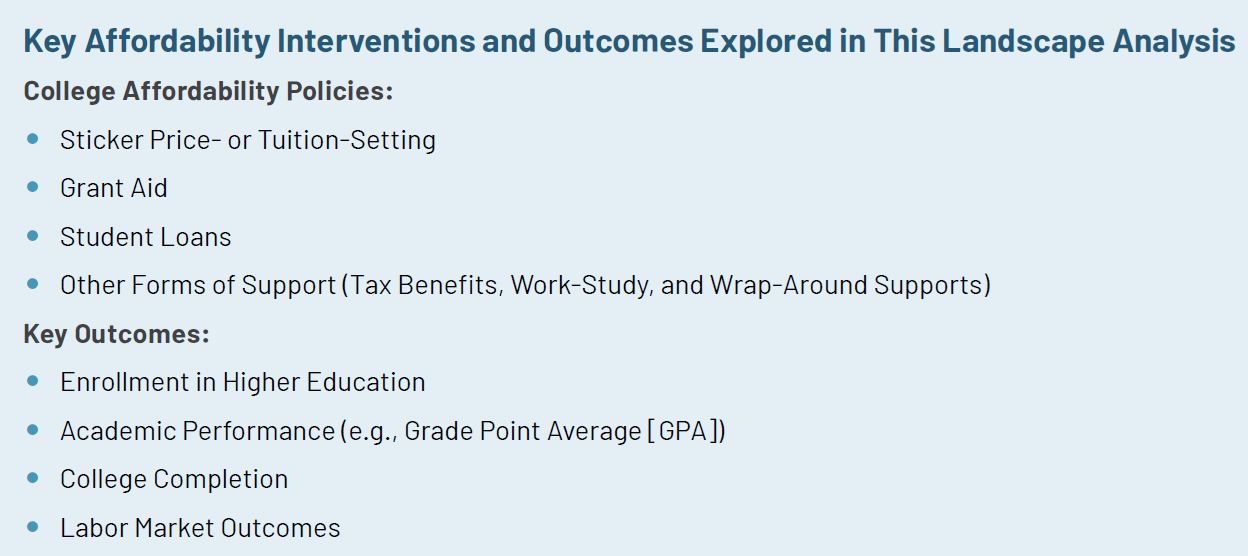
Both federal and state governments, as well as higher education institutions and private actors, are engaged in myriad efforts designed to address that challenge and make college more affordable. These include policies to lower college “sticker prices” or cap their growth, free-college programs, grant programs in many forms, policies to subsidize access to loans for college or to subsidize repayment of those loans (including through loan forgiveness), and so-called “wrap-around” financial support services like nutrition assistance to help pay for costs of living, among others. In this report we survey the evidence on each of these four broad types of affordability interventions. For each type of intervention, we give a sense for the weight of the evidence, across different studies, on its impact on student enrollment, academic achievement, degree completion, and post-college earnings outcomes.
Key Takeaways
“Small” effects can add up to large impacts. Many studies of affordability interventions find impacts on enrollment or completion of a few percentage points, and (if they study earnings outcomes) might estimate impacts on the order of a few percent. It is important to keep in mind that small or modest-seeming impacts, applied to a large number of students and sizable lifetime earnings, can lead to meaningful changes.
While the evidence is not definitive, there is an emerging consensus about the importance of several factors that mediate whether affordability interventions are successful:
The transparency of benefits and application complexity is important to their effectiveness.
Interactions between aid programs can enhance or undermine the impact of other programs.
The impact of affordability policies on the quality of colleges students attend is an important mediator of impacts.
Grant aid programs, whether need-based, merit-based, or veteran-serving, have been shown to improve college enrollment, completion, and post-college labor market outcomes. However, there are many other design details for grant programs where the evidence base remains unclear.
There is good evidence that access to student loans can improve students’ academic outcomes. Still, research on the impact of student loans in the U.S. has fallen short of providing high-quality evidence to guide recent policy debates. With a handful of important exceptions, researchers have not been able to holistically assess the impact of student loans, including their impacts on students’ post-college financial outcomes.
There is no evidence relating to how repayment subsidies, through their impact on the expected costs of college, influence student outcomes. Despite the considerable efforts, and substantial price tag, invested in student loan repayment changes in recent years, there is no real evidence to suggest whether or which of the design elements of various repayment plans have direct impacts on students’ likelihood of enrollment in college or their outcomes afterwards.
Tax credits for college expenditures are one of the only types of affordability policies that have not been shown to be effective in improving any of the college outcomes we examine. Even as the evidence remains relatively thin, available signs seem to suggest that the current tax benefits have virtually no impact on whether and where students enroll, whether they persist and complete college, or whether they see higher earnings after college.
Despite promising signs of impacts on persistence and completion, the body of research into wrap-around supports that colleges and nonprofit organizations provide remains incomplete. An important area for continued research is in the longer-term impacts of such efforts on completion and labor-market outcomes.
Conclusion
In the coming decades, policymakers will undoubtedly continue to pursue efforts to reform the U.S. higher education system so that college is more affordable for more students, helping to close gaps in enrollment and attainment between individuals from low- and high-income families. Researchers can and should look ahead to the design challenges policymakers will face and seek to fill these holes in the evidence base so that their efforts move us more rapidly towards the opportunity imagined under the Higher Education Act more than 60 years ago.