This report was co-authored and co-published by the PEER Center and the Washington Student Achievement Council. Read the full report on WSAC’s website.
In the One Big Beautiful Bill Act passed in July of 2025, Congress extended Pell Grant eligibility to very-short-term certificate programs for the first time. While the federal grants have traditionally been rationed to programs that are at least 15 weeks long, the so-called “Workforce Pell” program will make subsidies of up to $3,982 (based on the Pell award for the 2026-27 award year) available to students pursuing certificates 8 to 14 weeks and 150 to 599 clock hours.
The policy was debated for years before enactment: Supporters argued such grants provide an on-ramp to valuable training opportunities for lower-income and adult students who might not otherwise be able to sacrifice time away from the labor market or family responsibilities to pursue a longer credential. Others worried that the earnings outcomes of such programs tend to be low, and subsidizing them might divert students away from enrollment in more valuable credential programs. The final legislation seeks to respond to those concerns by including a lengthy set of requirements and guardrails, discussed in more detail below, though their effectiveness in ensuring Workforce Pell grants go to high-quality programs remains to be seen.
It will take time to fully evaluate whether this new source of funds ultimately proves to be a chute or ladder promoting upward mobility for lower-income Americans. However, this report takes a preliminary step, by painting a picture of the landscape of sub-baccalaureate credentials offered by public institutions in the state of Washington in the years prior to the creation of Workforce Pell. We describe the credential programs that are likely to be eligible for Workforce Pell; the characteristics of students enrolled in short-term certificate programs relative to other sub-baccalaureate credentials, with an eye on the extent of stratification of students by demographic and academic characteristics across credential programs of differing lengths; and the earnings outcomes of students earning credentials in these programs. Throughout the report we compare the short-term certificates to other sub-baccalaureate programs, including longer certificates and associate degrees.
We find that:
Very-short-term certificates (1-19 credit hours) make up about half of the certificates awarded in the state.
Those who hold very-short-term certificates are more likely to be adult students, with more than 61 percent over the age of 26, and more likely to be students of color, than associate or bachelor’s degree programs.
Earnings—and hourly wages—vary widely across fields and certificate lengths. Figure 1 shows earnings outcomes for certificates of different lengths for all fields of study where at least one very-short-term certificate is offered. Among these, very-short-term certificates (1-19 credits) have typical earnings measured three years after completion ranging from $21,500 to more than $75,000.
Figure 1: Median Annual Earnings Three Years Post-Completion, by Credential Level and Field of Study, for Fields with At Least One Very-Short-Term Certificate
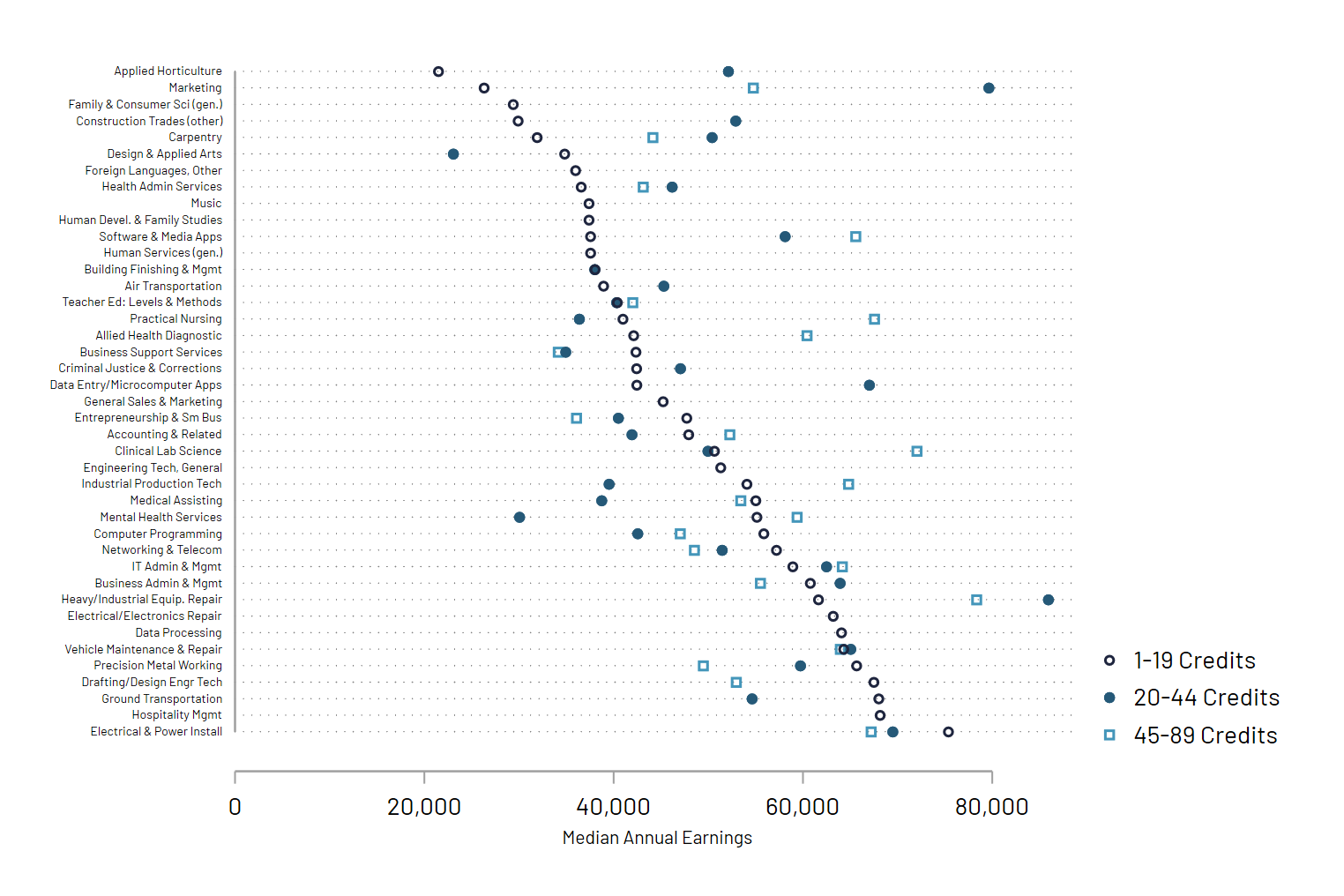
Notes: These data reflect the median annual earnings three years post-completion for the 2020 completer cohort, the most recent available cohort, and include fields of study (CIP4) that have at least one very-short-term (1–19-credits) certificate program. For detailed data on median earnings by field of study, credential type, and measurement timeframes, see Appendix Table A6. For the most recent detailed data on median earnings by field of study and credential type, see Appendix Table A7. Earnings are reported in real 2025 dollars.
Annual earnings across fields of study may not represent the full picture of graduates’ labor market success. Different fields of study could end up with similar levels of annual earnings, but very different hourly wages if graduates in one field are more or less likely to work on a part-time basis. For example, graduates with very-short-term certificates in family and consumer sciences typically earn close to $35 per hour – similar to graduates with a certificate in medical assisting. However, the median three-year earnings for family and consumer sciences graduates are about $29,400, compared with nearly $55,000 for medical assisting. These differences illustrate the importance of understanding both the median annual earnings and median hourly wages across credentials.
While many of the most popular programs will likely meet Workforce Pell standards for earnings and employment, not all will. Among the five most common very-short-term certificates awarded in Washington state—teacher education, vehicle maintenance and repair, medical assisting, clinical lab sciences, and practical nursing—all have more than 70 percent of graduates employed one year after completion. Additionally, all but one program, practical nursing, have median earnings above the approximate threshold of 150% of the federal poverty level ($23,475 in 2025). Figure 4 gives a very rough sense for how very-short-term certificate programs might fare in meeting these criteria.
Figure 4: Relationship Between the Share of Graduates Employed and Median Annual Earnings, One Year Post-Completion, by Field of Study for Very-Short-Term (1-19 Credits) Certificates
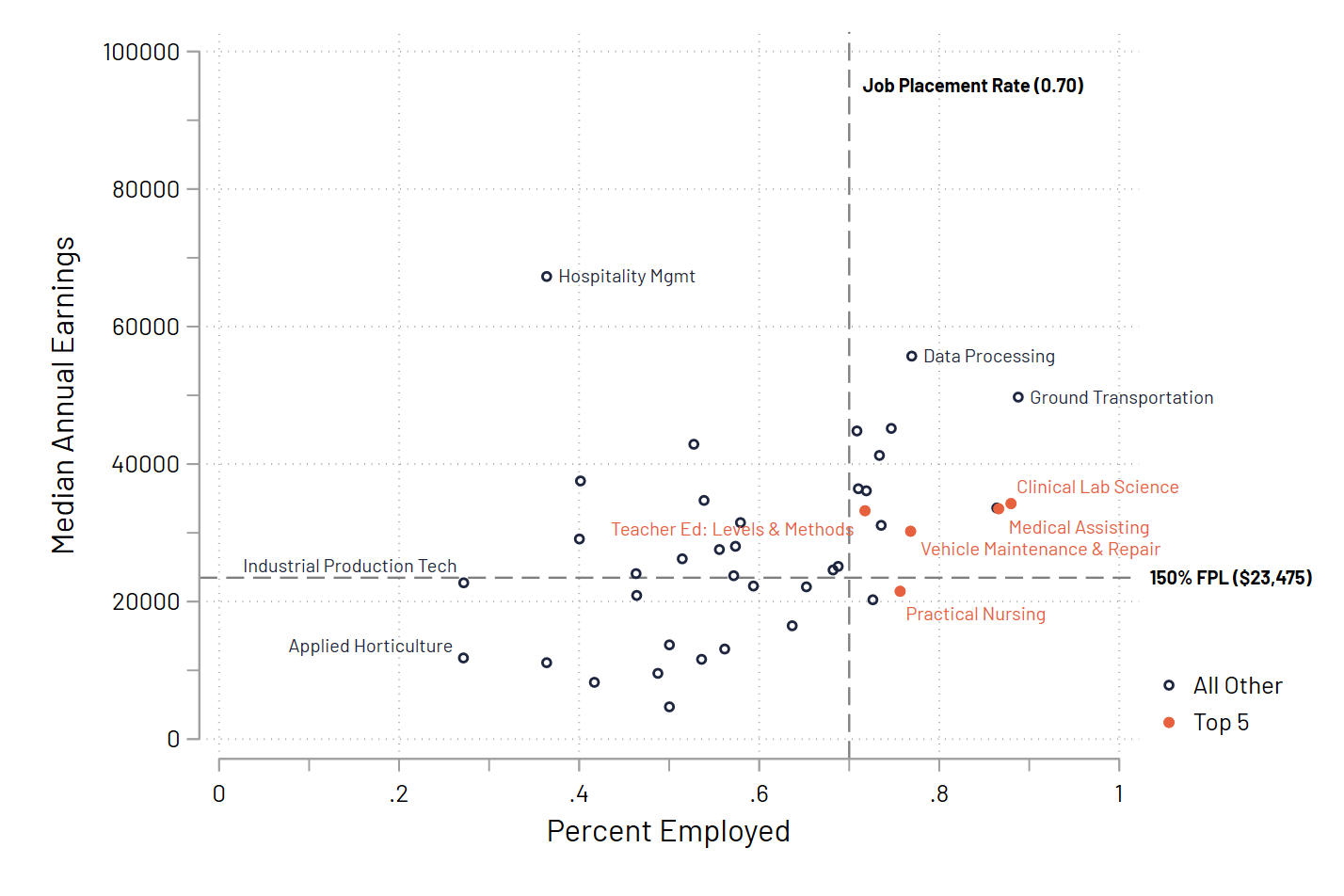
Notes: These data reflect the share of graduates employed and the median annual earnings one year post-completion for the 2020 completer cohort, and include all very-short-term (1–19 credits) certificate programs. The most commonly awarded very-short-term certificates are indicated by the solid orange dots and corresponding labels. For the most recent detailed data on median earnings and percent employed by field of study and credential type, see Appendix Table A9. Earnings are reported in real 2025 dollars.
As Workforce Pell implementation ramps up across the country, states like Washington will learn more about the current short-term program offerings in their state – and, importantly, how they compare with other types of certificates and degrees. This report offers a first look at the types of short-term credentials that might qualify for Workforce Pell in Washington state, and the characteristics of the students they serve. While there is considerably more work to do to identify the programs that fit the specific program length benchmarks for Workforce Pell programs, we find substantial variation in the earnings and employment outcomes of the programs – factors that could affect whether programs qualify for Pell Grants if they do not meet the job placement rate and earnings standards of the new federal framework.
More broadly, these data provide a foundation for states to consider the labor market returns of their sub-baccalaureate credentials across all types of programs—including not only Workforce Pell, but also the Workforce Innovation and Opportunity Grant, Perkins Career and Technical Education funding, and other types of federal financial aid from the U.S. Department of Education; servicemember and veterans education benefits; and state grant and loan programs. States have a unique role to play in helping to ensure their residents see positive economic returns to their higher education and workforce training programs, and data like these help to lay the groundwork for measuring and understanding the outcomes of program graduates.