What’s the Harm in “Do No Harm”?
Comparing Accountability Before and After the One Big Beautiful Bill Act
In the One Big Beautiful Bill Act, passed in the summer of 2025, Republicans in Congress created a statutory accountability framework that eliminates eligibility for federal student loans to students in higher education programs where graduates’ earnings are low. This “Do No Harm” provision, as it was dubbed by Senate Republicans, requires that the typical completer of each undergraduate degree program outearn young adults with only a high school diploma in the same state, and that the typical completer of any graduate program outearn the typical person with only a bachelor’s degree in the same field of study.
Notably, undergraduate certificate programs were excluded from this standard. Senate Republicans noted that this was because such programs were instead covered by the “gainful employment” (GE) regulations. The GE rules, first written in 2009 and reissued most recently in 2023, define a provision in the Higher Education Act that requires nondegree (i.e., undergraduate or graduate certificate) programs in any sector, and degree programs at for-profit colleges, to lead to gainful employment in a recognized occupation. That definition, under the 2023 rules, requires programs to meet two standards in order to be eligible for Title IV federal student aid: Their graduates’ earnings need to be higher than those of the typical high school graduate, and their debt service payments need to be affordable relative to their earnings.
Among advocates of accountability in higher education, the new statutory framework for accountability was heralded as progress in creating accountability for all programs – going beyond the 2023 Gainful Employment regulations to apply accountability across all sectors. Indeed, the OBBBA provisions represent the first meaningful statutory effort to hold institutions accountable for student outcomes in at least 40 years, and had the existing Gainful Employment (GE) regulations been left in place, they would clearly have expanded accountability to more higher education programs. But with some underlying differences in both the approach to measuring performance and the consequences to low performance between the Do No Harm framework and the 2023 rules, the Department of Education opted instead to reregulate the GE rule to match the OBBBA standards.
While the final rule implementing the OBBBA framework for both GE and non-GE programs has yet to be issued, the new accountability regime would weaken accountability for many programs. Paradoxically, they would leave fewer students protected from low-financial value programs than the 2023 GE rules, despite those rules applying only to non-degree programs and degree programs in for-profit colleges. While the new rules expand coverage to public and nonprofit undergraduate and graduate degree programs, there are few programs in those sectors that fail. Most of the students enrolled in failing nonprofit programs are in graduate programs where earnings fall below the $60,000 threshold of the typical bachelor’s degree-holder, but their earnings are generally not exceptionally low. Graduate degree programs at for-profit colleges and graduate certificates at all institutions would be held to a more stringent earnings test relative to the 2023 GE rules, but the elimination of the debt-to-earnings test would allow more programs with high debt and modest incomes to avoid accountability sanctions. Meanwhile, the proposed rule generally holds undergraduate certificate and degree programs accountable to a lower performance bar. As a result, the programs that fail under the statute and new regulations are on average not as low-performing as is the case under the 2023 GE rules.
More importantly, the consequences for failing the new GE rule would be limited to the loss of federal loan eligibility, rather than the loss of eligibility for all Department of Education financial aid programs, including Pell Grants. Since about half of all federal financial aid recipients receive only Pell Grants, this dramatically reduces the financial consequences of the new accountability rules. Taken together, the consequence of these changes to accountability rules is that many fewer students in low-financial-value programs will be affected by the new rules post-OBBBA than under the gainful employment rules in place prior to its enactment.
Number of Affected Students in Failing Programs, by Framework and Credential Level
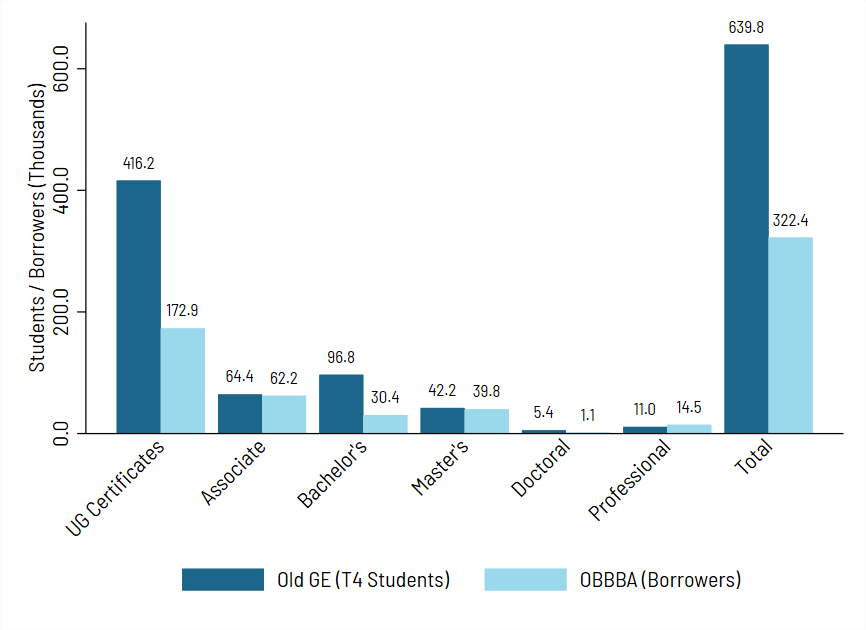
Source: PEER Center analysis of U.S. Department of Education data. Note: Post-baccalaureate and graduate certificates are not shown separately, but are included in the ‘Total’ category. The number of affected students includes all Title IV recipients for modeling ‘Old GE,’ and only federal student loan borrowers for OBBBA (including the new GE rules).