This report was published through the Federal Reserve Bank of Philadelphia’s Consumer Finance Institute.
Graduate student borrowing has grown substantially over the past two decades, both in aggregate and per borrower, and now accounts for nearly half of all annual federal student loan disbursements. As high graduate debt levels become increasingly common, concerns have been raised about weak labor market outcomes at many programs that entail substantial borrowing, motivating new limits on federal graduate borrowing enacted in the One Big Beautiful Bull Act of 2025 (OBBBA).
Recent analyses, including our own previous report, show the new limits will bind for many borrowers — an estimated one-third of new federal student loan borrowers. These borrowers—up to a half million per year once the limits fully phase in—will likely seek loans from private lenders for the additional funds beyond what they can borrow from the federal government to pay for their education, or change their plans for graduate study. Our previous report used credit score data for federal graduate loan borrowers to estimate the fraction of them that would likely be unable to qualify for private student loans based on sharp eligibility thresholds currently used by many lenders.
This report builds on that analysis. First, we provide the first systematic evidence on how graduate student loan performance varies with the characteristics of borrowers, loans, and the institutions and programs that borrowers attend. Combining enrollment records with credit bureau data and program-level earnings, we measure three-year default among federal graduate borrowers who entered repayment between 2011 and 2016. Overall, recent cohorts of graduate student loan borrowers appear to be relatively high performing, with much lower rates of default (4.1 percent default within three years) and delinquency (12.6 percent experienced delinquency of 90 or more days past due) compared with undergraduate loans. Students whose borrowing exceeded the new limits defaulted more often than others, but loan size alone is a coarse signal of repayment risk; overall, 60 percent of graduate defaulters borrowed below the limits. Pre-enrollment credit scores are the strongest predictor of default among the factors we examine, followed by the credential pursued and the median earnings of a program’s past graduates.
Three-Year Default Rates for Graduate Borrowers by Annual Loan Size, by Credential
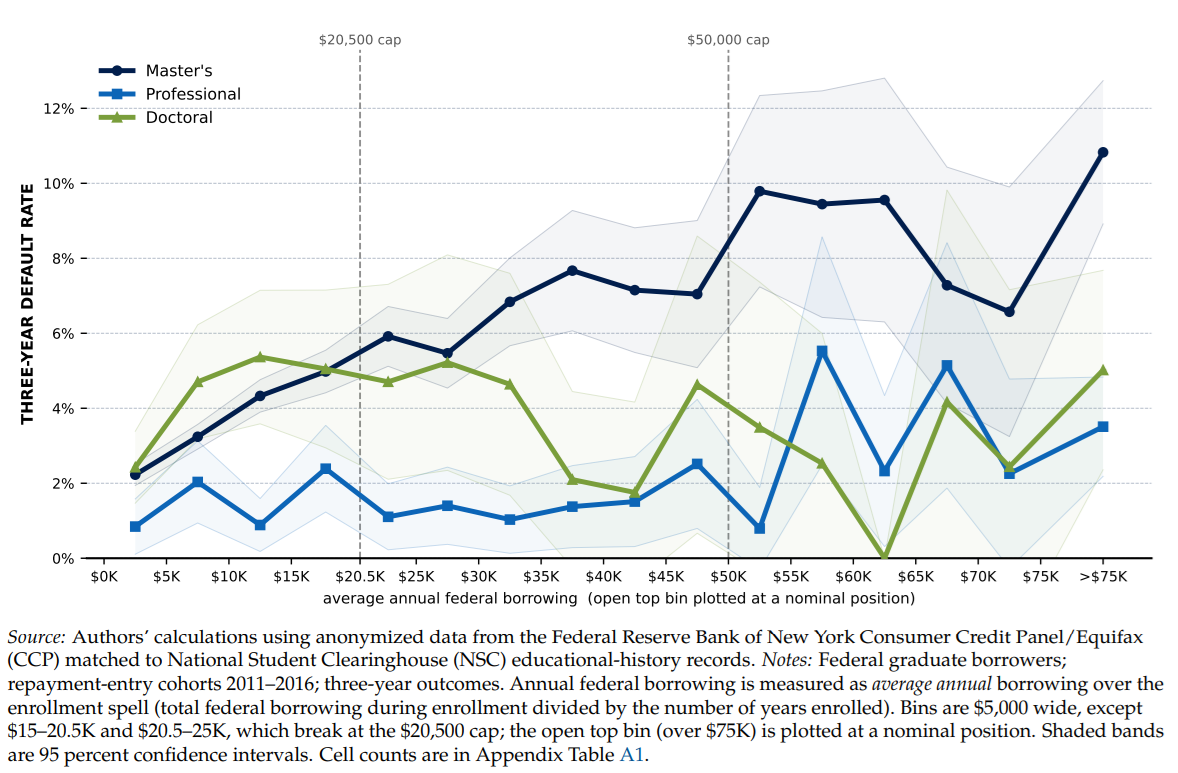
Second, a key concern with the withdrawal of federal credit availability highlighted in our earlier report is that about 40 percent of graduate students who rely on federal loans have no credit history or have sub-prime credit scores. Such students are unlikely to qualify for private loans without a creditworthy cosigner. Some observers hope that an increase in the use of “forward-looking” underwriting—that is, underwriting based on forecasts of students’ future earnings, rather than prior credit history and income at time of application—may allow these students to access credit to attend programs with strong labor market returns. Among borrowers with low or no credit scores, those in high-earning programs default at far lower rates than those in lower-earning ones.
Three-Year Default Rates for Graduate Borrowers, by Program Earnings Groups
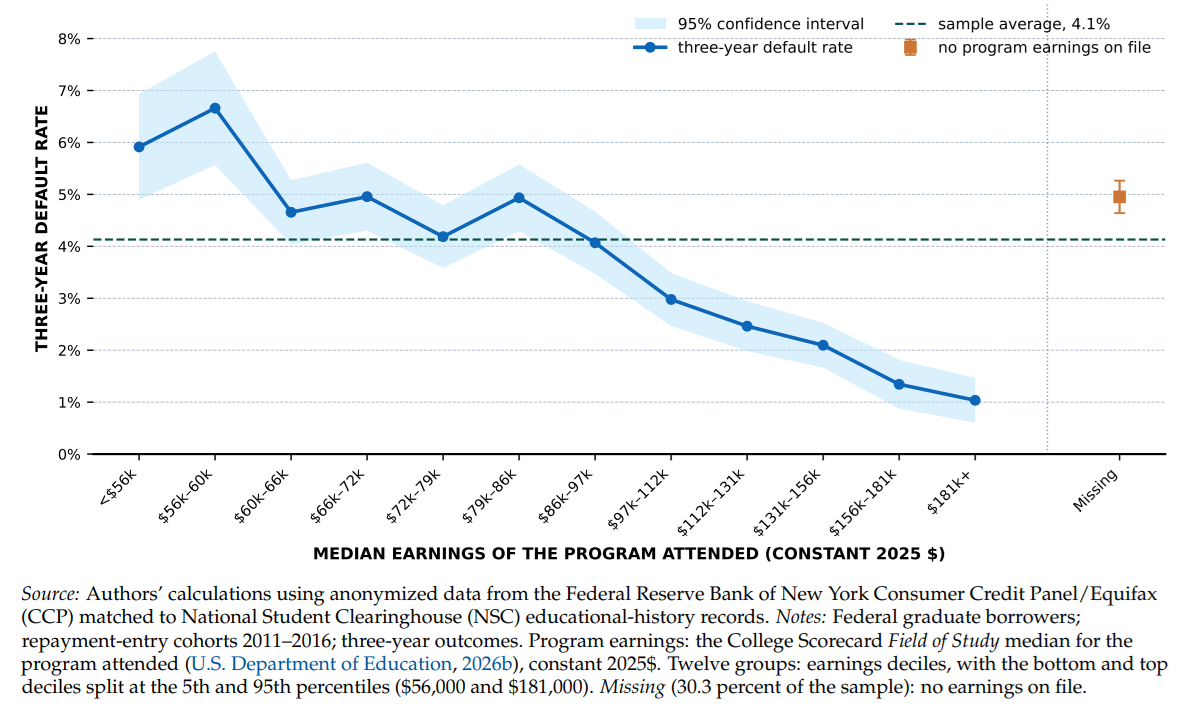
This report documents how three-year default and delinquency among federal graduate borrowers entering repayment between 2011 and 2016 vary with loan size, pre-origination Risk Score, credential, institution sector, field of study, and the earnings of prior graduates of the borrower’s program. Historically, borrowers whose federal borrowing exceeded the new OBBBA limits defaulted about twice as often as those below them (6.5 percent versus 3.3 percent), though not among Doctoral borrowers. Risk Scores strongly predict default, yet within the lowest Score bands and among borrowers without a Score, default falls