This report was originally published by the American Enterprise Institute.
The new federal loan limits established by the One Big Beautiful Bill Act (OBBBA) promise a dramatic shift in how graduate and professional students finance their advanced study. Federal data on borrowing patterns from 2019–20 suggest that as many as a half million graduate students each year (over one-third of the 1.4 million who borrow federal loans in a typical year) will have their access to loans from the federal government reduced, sending many of them to private lenders to help pay for their education.
Federal Graduate PLUS (Grad PLUS) loans have allowed students to borrow up to the full cost of attendance for any graduate program. For the architects of OBBBA, replacing that near-entitlement with private-lender underwriting—and therefore rationing access to credit—was the point. The hope is that market forces will encourage credit to concentrate in programs where earnings outcomes justify the amounts being borrowed—creating more market accountability for low-performing and overpriced programs.
While this vision for a future of increased private-sector involvement in student loans may seem intuitive, it reads as fanciful against the past and present of private education lending. Private lenders have not traditionally made lending decisions based on estimates of students’ future earnings according to their intended program of study or the institution they plan to attend. Underwriting decisions—whether students get loans, how much, and at what price—tend to be based instead on “backward-looking” information such as credit scores, current income, and a cosigner’s creditworthiness.
Figure 1. How Underwriting Methods Affect Who Gets Credit
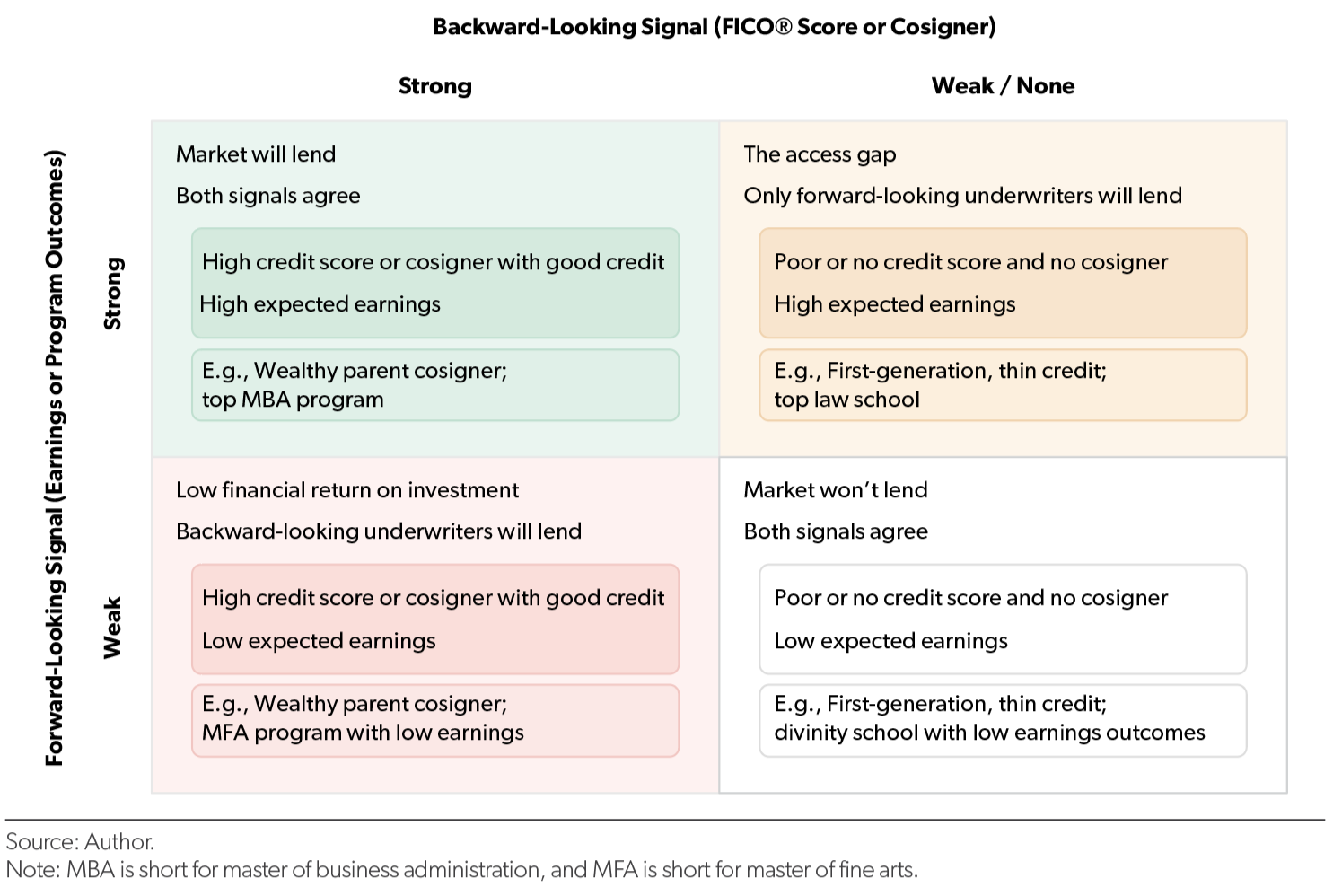
There are exceptions, and a growing number of lenders now offer products based on estimates of students’ future earnings. But these products remain a small share of the market, and important constraints may continue to limit the role of such “forward-looking” underwriting—some technical, relating to data availability, and some legal, relating to fair-lending compliance risk. This report offers an overview of these issues and concludes with a discussion of how different stakeholders might facilitate a more successful transition to a post–Grad PLUS world.