Do Graduate Degrees Pay Off?
This piece was featured in The Washington Post and Inside Higher Ed, among other sources.
Estimates from Texas Administrative Data
Graduate education has become an increasingly important part of higher education in the U.S. Among adults aged 35–39 with a bachelor’s degree, the percentage with a graduate degree grew from 31 percent in 1993 to 42 percent in 2022. The rapid growth reflects the economy’s increasing demand for high-skilled labor, but there is growing concern about the debt burden incurred in graduate school. Whether graduate education is worth its cost is a critical question for both prospective students and policymakers. Students need this information to determine whether they would like to pursue graduate school and, if so, in which programs to consider enrolling. Policymakers need this information to hold higher education institutions accountable for government funding and to identify high-potential graduate programs to further invest in, particularly in light of recent legislation that would substantially constrain access to federal credit for graduate programs.
In our recent paper, Altonji and Zhu (2025), we exploit the richness of the Texas Education Research Center (ERC) administrative data to provide more credible causal estimates of the labor market returns to 121 specific advanced degrees. In this report, we focus on three sets of results. First, we find that, on average, graduate programs increase students’ earnings by around 17 percent. However, the returns to earnings differ widely across fields, with professional degrees in medicine (MD) and law (JD) and master’s degrees in business administration (MBA) yielding 110 percent, 59 percent, and 16 percent returns, respectively, while master’s degrees in curriculum and instruction and master’s degrees in clinical psychology yield returns around 4 percent.
Second, accounting for the costs of enrollment and foregone earnings while students are in school is important. Once adjusted for these costs, the increase in total lifetime income is typically smaller than the effects of graduate degrees on earnings. For example, a JD program, which takes three years, has relatively high tuition and low earnings during enrollment, resulting in a substantially lower (but still high) adjusted return.
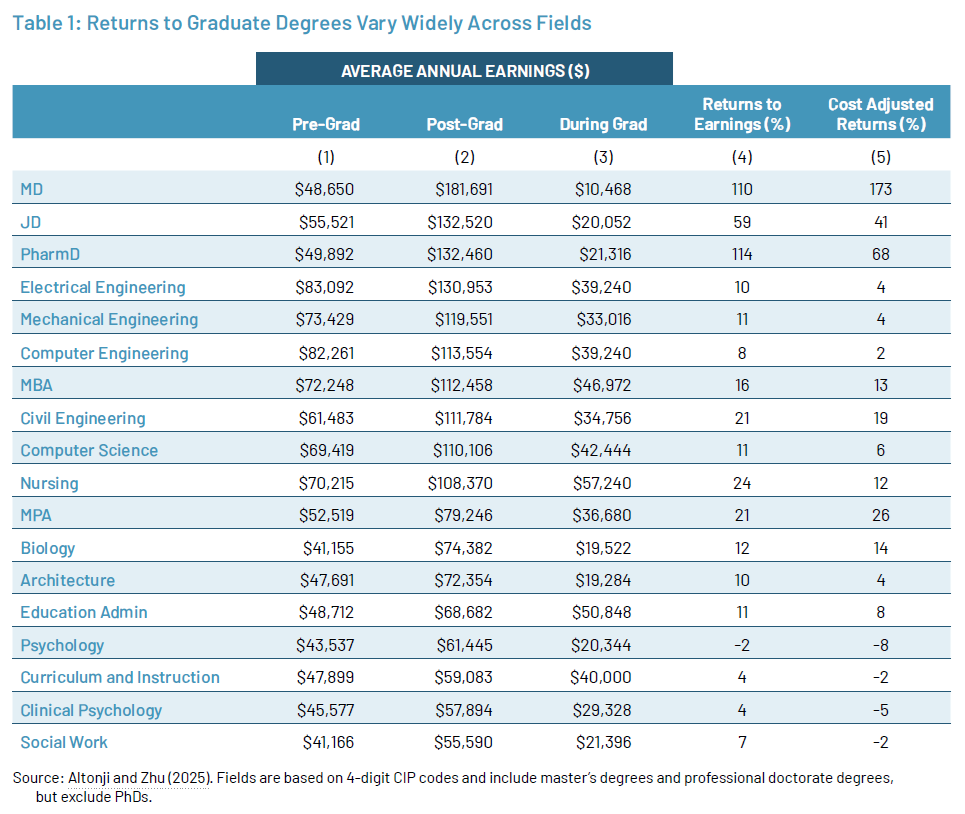
Third, we explore how the returns to graduate degrees differ across student and program characteristics. Generally, earnings effects are higher for women, lower for part-time students, and higher for students from lower-paying undergraduate majors. We also find that JD and MBA programs ranked highly in the U.S. News & World Report rankings tend to have higher returns than lower-ranked programs. Together, these three sets of results demonstrate the large variation in the value of graduate education by field, program, and student types.
With the variety of graduate degree programs in the U.S. higher education system and the rise in investment in graduate education, it is critical to provide students and policymakers with reliable quantitative measures for programs’ financial value. In this research, we demonstrate that simple measures, such as average post-graduate school earnings, may understate the returns to graduates of some fields, and overstate the returns to others. To assess the causal earnings gain to graduate education, it is critical to consider students’ outside options, tuition, time-to-degree, and potential earnings during graduate school. Such adjustments are feasible for policymakers. For instance, recent legislation passed by Congress will assess the median earnings of graduate programs relative to the lesser of earnings for a bachelor’s degree holder either generally or in the same field. This approach, although quite simplified, is generally consistent with our findings. There is also potential for public policies to better support students through programs that are most likely to yield the largest labor market return through graduate education.