What Drove the Drop? For-Profit Colleges and the Decline in College Advertising
For the first brief in this series, “Where Did All the Ads Go?,” click here.
Colleges in the United States have cut their commercial advertising spending in recent years. Between 2014 and 2022, expenditures on commercial advertising (e.g., television, radio, outdoor ads, websites display ads, and social media) dropped by half, and most of the decline was attributable to cuts in advertising spending by the for-profit sector. In our first brief in this PEER Center series on college advertising, we documented these time trends in college advertising. In this brief, we begin to explore how, why, and which institutions contributed most to the decline, and how advertising patterns differ by sector.
We find that for-profit institutions far outspend institutions in other sectors: Institutions in the for-profit sector spend about four times more on commercial advertising than private nonprofit institutions, and 13 times more than public institutions. The average for-profit college spent about $176 per student in 2022, compared with just $59 and $14 per student for nonprofit and public institutions, respectively. These differences are not driven by the size of the institution: For-profits of all sizes far out-spend public and nonprofit institutions on a per-student basis.
Our analysis further suggests that school closures played a large role in decline of advertising spending. Institutions that closed or otherwise stopped advertising accounted for about 70 percent of the decline in advertising spending between 2010 and 2022.
Drops in For-Profit College Enrollment and Advertising Spending Over Time
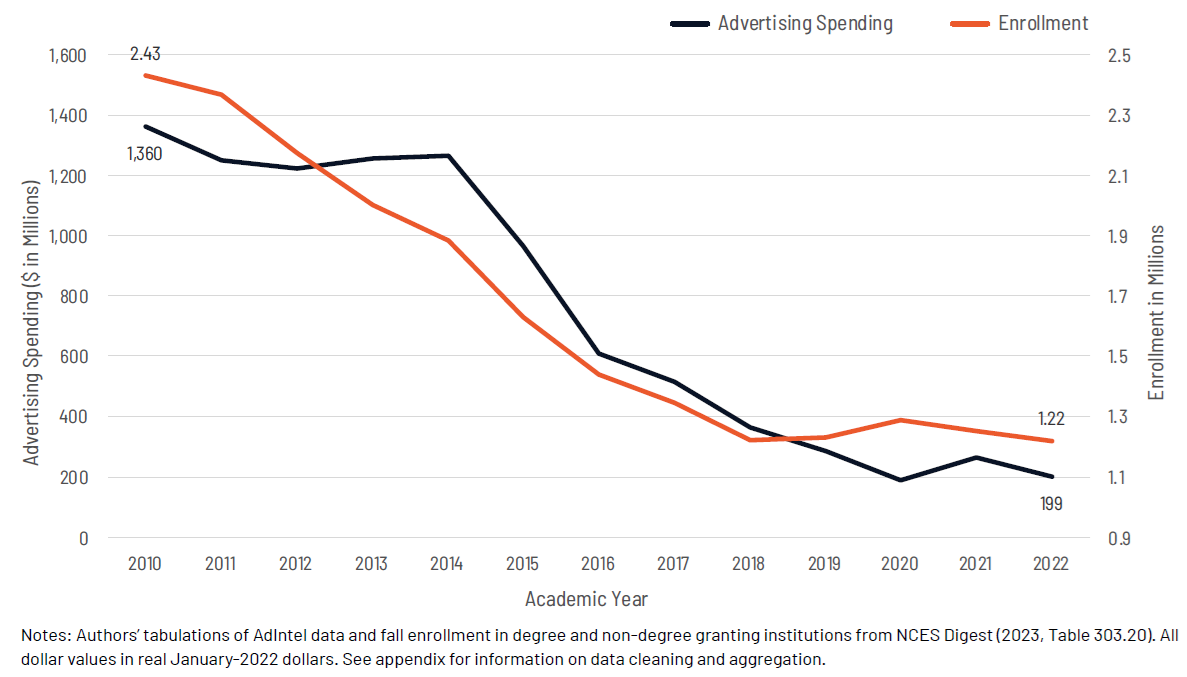
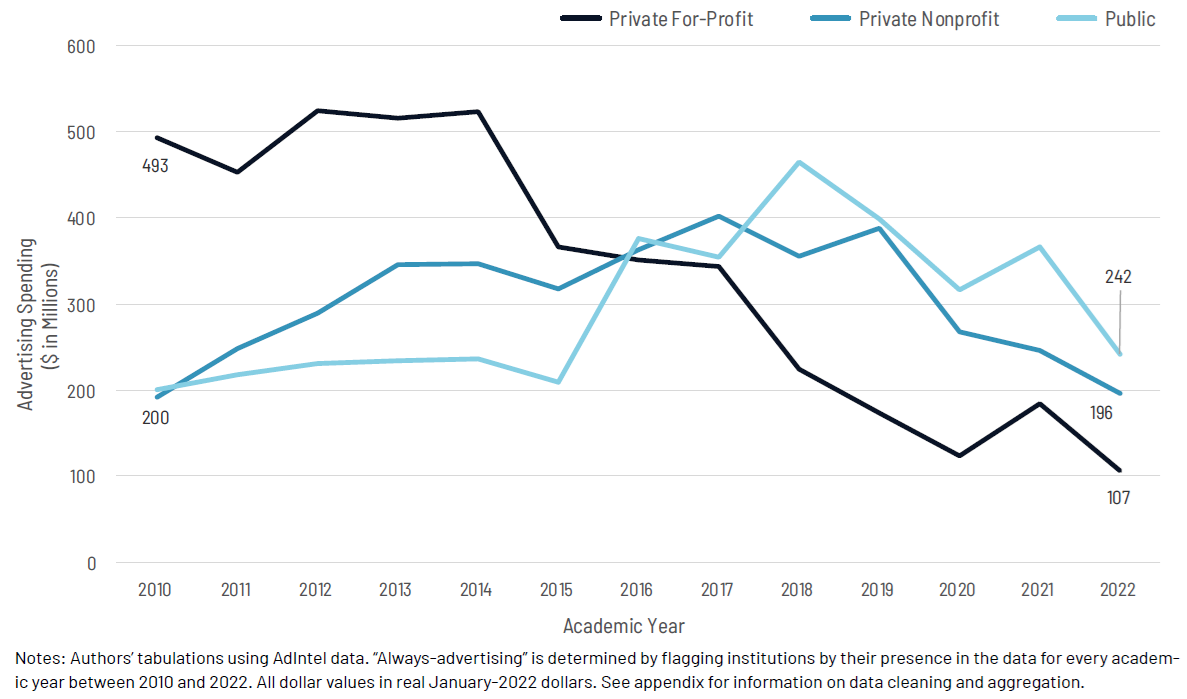
But closures are not the whole story; we see steep declines in advertising expenditures even among institutions that remain in our advertising sample in every year. It is evident that the switch away from television advertising to less-expensive digital media has also played a key role in reducing advertising expenditures among for-profit institutions.
Total Advertising Spending by Control Among Always-Advertising Schools
The AdIntel data also allow us to explore—for the first time—how spending on commercial advertising relates to other types of spending by institutions. The most comprehensive data source on institutional finance, the IPEDS finance survey, combines many different types of expenditures into broad categories, such as student services, academic support, and institutional support, making it difficult to assess spending within any of these groups and impossible to see advertising alone. To better understand where and how advertising might be reported in the IPEDS—and how advertising spending compares to total spending more generally—we compare advertising spending reported in the AdIntel data to spending in the broad categories reported in IPEDS. We consider three main types of support expenditures together: student services, academic support, and institutional support, a new category we call “general support.” Advertising spending by for-profit colleges is equivalent to about 75 percent of all general support spending in 2010, compared to under one percent for the other sectors. Our analysis suggests that it seems plausible that advertising is reported in various categories across these three measures.
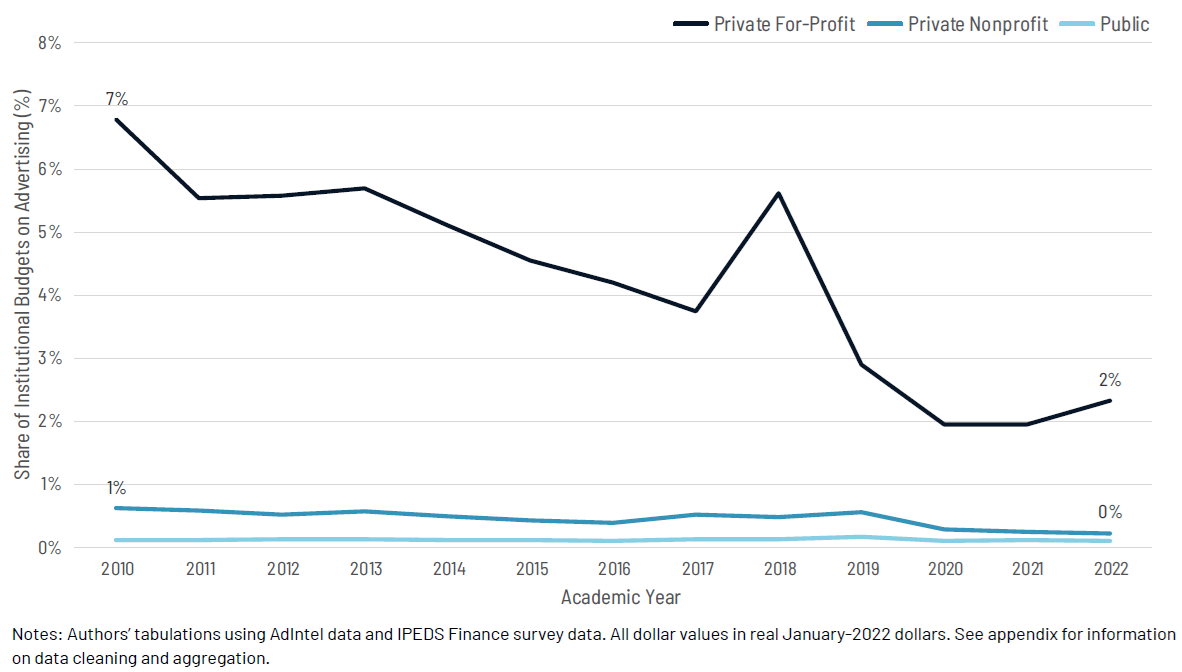
Finally, we consider advertising spending relative to total spending. For-profits spend a much larger share of their overall budget on advertising than public and nonprofit institutions. In 2010, for-profit institutions spent about 7 percent of their budgets on advertising. The proportion has declined since then, to just 2 percent in 2022. Again, the share for nonprofit and public institutions is much lower—under half a percent, rounded to zero.
Average Advertising Spending as a Share of Total Expenditures, by Control